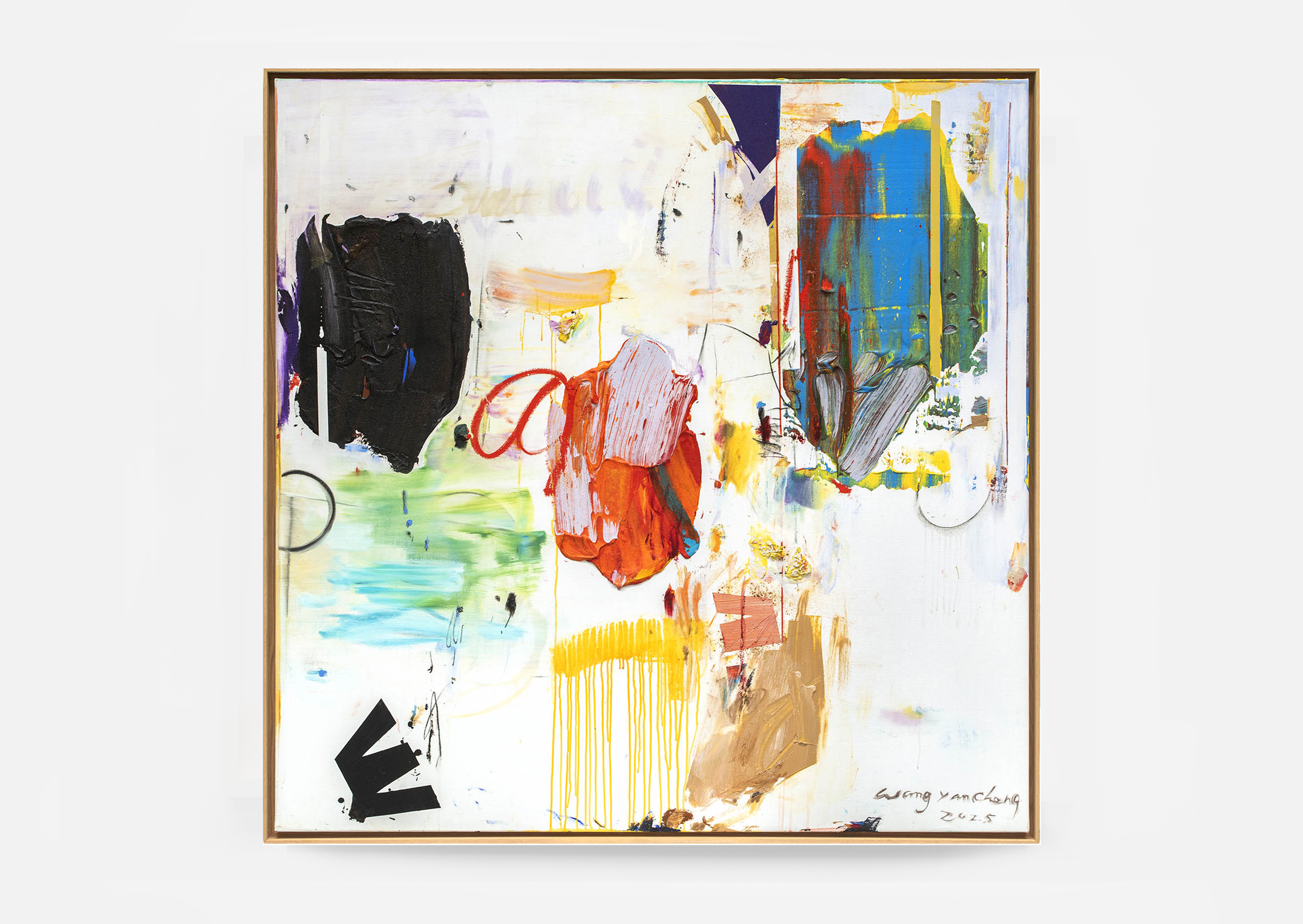
In the summer of 2025, Wang Yancheng was invited to exhibit at the Galleria dell’Accademia in Florence, in a vast room a few dozen meters from Michelangelo’s marble David. The exhibition was titled “Luce, energia e infinito.” This Italian consecration, preceded in 2020 by an exhibition at the Galleria d’Arte Moderna in Rome, followed recognition in Japan in 2025 at the National Museum in Tokyo: “Wang Yancheng’s World.”
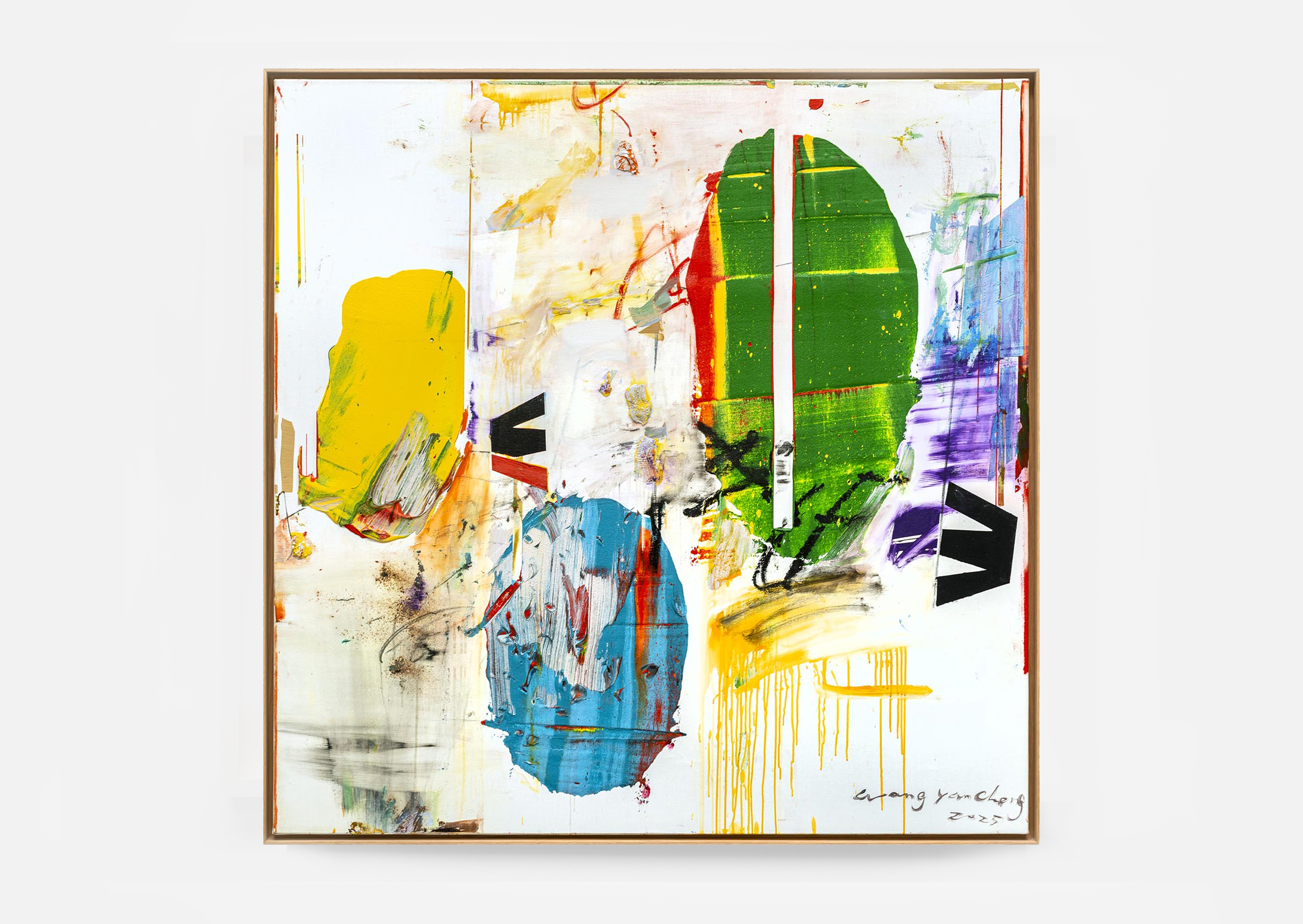
The work of this painter of Chinese culture and training, who very quickly opened himself to an international dimension of art while remaining faithful to the path he began under the benevolent gaze of Zao Wou-Ki and Chu Teh-Chun, is now reaching full maturity. Sometimes too hastily filed under the easy label of Lyrical Abstraction, Wang shapes a highly personal pictorial world in which space now becomes airier and opens onto tensions that might be described as cosmic.
“I paint by respecting my intuition and my sensations,” he writes. “Freed from the pressure of the traditions that constrain, I let the memory nestled at the heart of my being surge forth.”
Over the past two years, the artist has worked on paper for the first time in a long while. For his second exhibition at the gallery, two superb series were created on very thick watercolor paper: the suite Impact in 2025 and the suite Contrecoup in 2026. The constraint of the 77 x 57 cm sheet leads the painter to reconcile extreme tension with controlled release.
“I use the intervals and distances in the visual field, as well as the interactions between entities, in search of a field of energy,” he states.
It is with good reason that the neologism “chaosmos,” coined by James Joyce in Finnegans Wake and taken up by Gilles Deleuze in 1968 to signify the internal identity of the world and chaos, has been borrowed to describe Wang’s pictorial world. This is the challenge Wang has set himself.
“The very singular quality, one might say the major event that defines the events of Wang’s painting, is in fact that it is a kind of brief, devastated and unstable transit between two indeterminable places. Looking at his canvases, we are transported to another, invisible place, of which the canvas is the point of passage, at once blurred and pressing, unavoidable and yet contingent.” Giorgio Agamben